Flamenco Compás: What It Is and Why It's the Soul of This Art
When you first start listening to flamenco, you hear a guitar, some handclaps, a voice, a pair of heels. Everything seems to move freely, almost as if each artist were following their own path.
But no.
There is a structure holding the singer, the guitarist, and the dancer together. A kind of shared code, passed down from generation to generation: the flamenco compás.
What Is the Flamenco Compás?
The flamenco compás is the rhythmic structure that organizes each palo. It sets the beats, the accents, and the silences that singing, dancing, and guitar all rest on.
Without it, there would be no way for three or four artists who have never rehearsed together to walk on stage and understand each other within seconds, as happens night after night in a tablao.
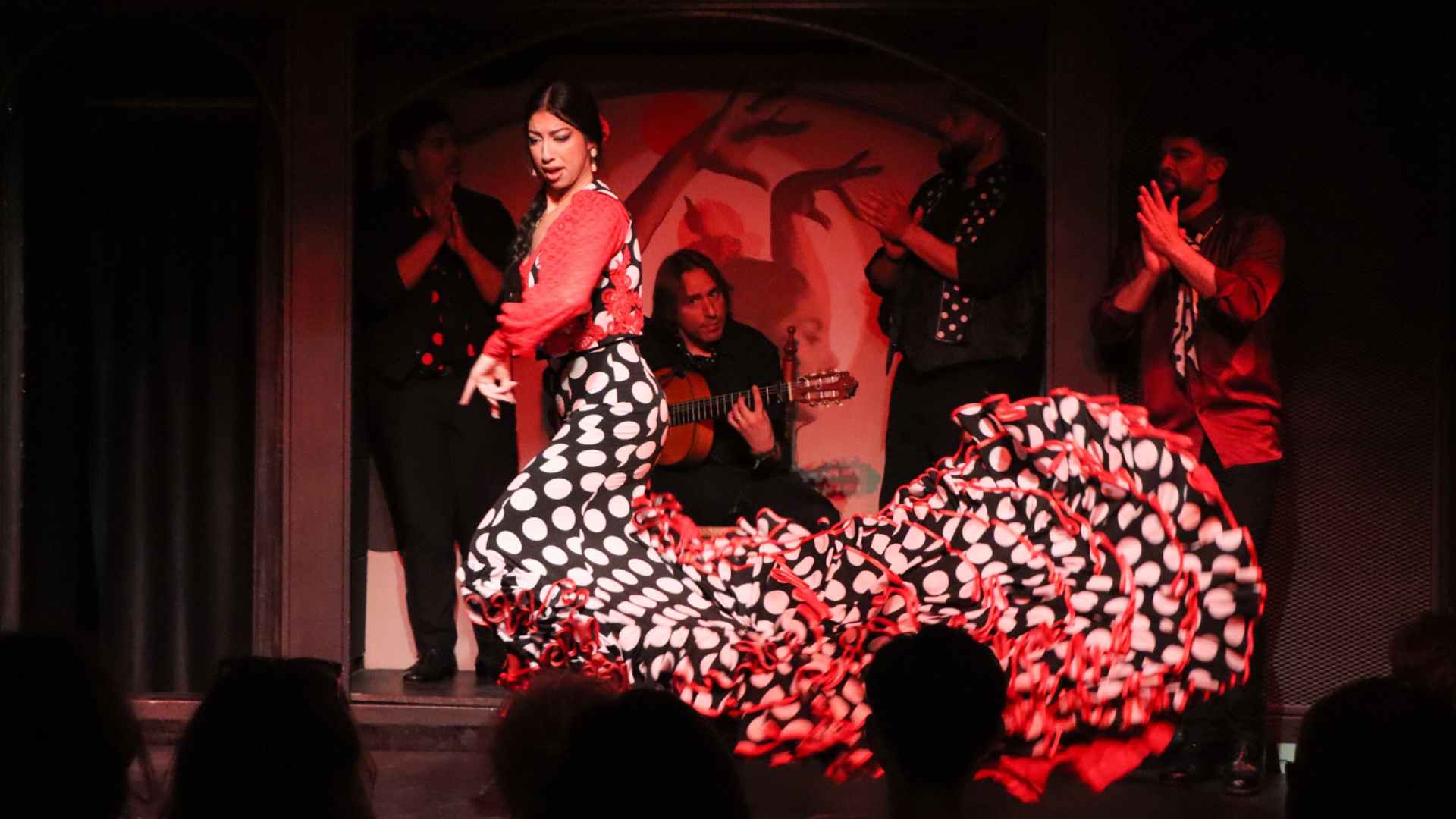
The singer knows exactly when to come in, the guitarist knows when to resolve his falseta, and the dancer knows where to land the final stamp of a zapateado. They all share the same invisible reference.
Structure and Main Types of Flamenco Compás
Here we run into one of the first hurdles for anyone coming to flamenco from other musical genres.
There is no such thing as the flamenco rhythm.
There are different families, different palos, and different ways of organizing and accenting the pulse.
To get your bearings, it helps to think in terms of three broad structures: 12-beat, 4-beat, and 3-beat compás.
The 12-Beat Compás
The twelve-beat cycle is one of flamenco's most distinctive traits.
It forms the backbone of essential palos such as the soleá, bulerías, alegrías, cantiñas, and seguiriya, although each one has its own accent pattern and tempo.
The 4-Beat Compás
Flamenco tangos, tientos, and rumbas use binary or four-beat structures that feel far more intuitive to an ear raised on Western popular music.
For someone just starting to listen to flamenco, the tangos compás is usually one of the most accessible. You can follow it with your body, a light tap of the foot, or simple handclaps, as long as you respect the intensity of the accents.
The 3-Beat Compás
Its feel may remind you of the sway of a waltz, though flamenco adds its own turns, accents, and phrasing.
It is characteristic of styles such as sevillanas, fandangos de Huelva, and verdiales.
Here the pulse can be felt in groups of three, but beware of a common oversimplification: sorting all of flamenco into "3, 4, or 12" is useful for getting started, not for explaining its full complexity.
Flamenco constantly plays with accents, subdivisions, and overlapping patterns.
That is precisely one of the reasons its rhythm has so much personality.
The Art of Keeping Time
Keeping time in flamenco is a ritual in itself, a complex interplay between artists that goes far beyond simple percussion.
Palmas, the handclaps of flamenco, are much more than accompaniment. They are another voice, an essential rhythmic instrument that, in the hands of a master, creates the signature groove known as soniquete.
Soniquete isn't just clapping. It's a particular way of accenting, of breaking the rhythm, of creating an unmistakable swing.
There are muted claps (palmas sordas, made with cupped hands) and bright claps (palmas sonoras, with the fingers of one hand striking the slightly cupped palm of the other). How they combine, and how the strokes anticipate or drag behind the beat, is crucial.
A good palmero can "talk" with the singer or the dancer, guiding and enriching the compás.
It's no coincidence that the palmero often acts as the group's human metronome, the invisible conductor holding the rhythm together.
But the compás isn't only expressed outwardly.
There is an even deeper, more personal phenomenon: the internal compás.
It's the flamenco artist's ability to feel the meter in their own body, to internalize the rhythm until it flows naturally.
It's that touch of duende that lets a singer stretch a phrase or a dancer toy with a silence, knowing instinctively where to land back on the exact count.
It's something cultivated through years of listening, practicing, and living the art.
This internal compás is what allows flamenco to be so improvised and, at the same time, so tightly knit.
It's the secret that separates a good artist from an exceptional one.
Mastery of the internal compás is the ultimate proof of flamenco command.
The Compás in Practice: Dance, Song, and Guitar
The flamenco compás is not an abstract theory. It is the central axis of performance.
In every facet of this art, the compás takes on an undeniable practical role:
In the Dance
In dance, the compás is the backbone of every movement.
The dancer uses their body as a percussion instrument, stamping, striking with the heel, and marking the accents of the compás with astonishing precision.
A great dancer doesn't just follow the rhythm. They interpret it, embellish it, break it, and rebuild it, revealing a deep understanding of the compás.
In the Song
The cante, flamenco's voice, is where it all begins. It organizes the relationship between the lyrics and the accompaniment, though the singer can stretch phrases, delay entrances, and play with the tension.
In the Guitar
The flamenco guitarist is in charge of laying down the harmonic and rhythmic foundation of the compás.
With strummed rasgueos, arpeggios, and falsetas (melodic variations), the tocaor weaves a web of sound that wraps around and supports the other artists.
The guitarist's ability to accompany a song or a dance, adapting to improvisation while holding the pulse steady, is fundamental.
The guitar doesn't just keep the compás. It decorates and enriches it, showcasing the immense rhythmic wealth of flamenco.
Together, this rhythmic interplay creates a constant dialogue between the artists, a wordless conversation in which the compás is the universal language.
You can read more in this article on traditional Spanish instruments.
Why the Compás Feels Better Live
However much the flamenco compás is explained with numbers and diagrams, it is above all a physical experience. You feel it in your chest before you understand it with your head.
That oral transmission, that energy that only happens when the singing, the guitar, and the dancing breathe in the same room, is why no video or recording can ever replace a tablao, which remains, a century and a half later, the natural stage for this art.
If you'd like to keep exploring before visiting a tablao, you can read our history of flamenco and its origins, or discover what a flamenco cultural experience in Barcelona is like.
And if, once you understand the compás, you want to experience it firsthand, come to El Duende.
Experience the Flamenco Compás Live at El Duende
At El Duende, in the very heart of La Rambla, the compás isn't explained. It's shared.
Our venue offers daily shows at 7:00 PM, 8:15 PM, and 9:30 PM, each lasting 50 to 55 minutes.
Every night, a rotating cast of six or seven artists blends established figures and emerging talent.
Want to hear what the compás sounds like just a few meters from the artists? Discover El Duende by Tablao Cordobes and enjoy a flamenco show in Barcelona in an intimate setting, with top-level artists and more than 55 years of tradition behind the project.