
Traditional Spanish Instruments: From the Flamenco Guitar to the Cajón
Spain is one of the most musically diverse countries in Europe. Every region guards its own sound: bagpipes drone in the green hills of Galicia, flutes and drums accompany dancers in the Basque Country, and in Andalusia the guitar weeps and thunders under a flamenco voice.
Understanding traditional Spanish instruments is one of the most enjoyable ways to understand Spain itself, because each instrument tells a story of migration, craftsmanship and celebration.
In this guide we tour the most iconic Spanish musical instruments, explain how they work and where they come from, and show you where to hear several of them live on a single stage at an intimate flamenco venue in Barcelona.
The Spanish Guitar: The Country's Great Gift to World Music
If Spain has given one instrument to the world, it is the guitar. The modern classical guitar took its definitive shape in 19th century Spain, thanks above all to the luthier Antonio de Torres, whose designs from the 1850s onward established the proportions, fan bracing and body size that virtually all classical and flamenco guitars follow today.
Within the Spanish guitar family, two siblings deserve separate introductions.
The classical guitar is built for warmth and sustain, usually with rosewood back and sides. It is the voice of composers like Francisco Tárrega, whose "Recuerdos de la Alhambra" remains one of the most beloved pieces ever written for the instrument, and of virtuosos like Andrés Segovia, who carried Spanish guitar music into the world's great concert halls.
The flamenco guitar looks similar but behaves differently. Traditionally made with cypress back and sides, it is lighter, brighter and more percussive, designed to cut through singing, dancing and palmas in a crowded room.
Flamenco guitarists use techniques rarely heard in classical playing: the rasgueado, a rapid strumming with the fingers unfolding across the strings; the golpe, a tap on the guitar's protective plate that turns the instrument into a drum; and the picado, fast scale runs executed with striking attack.
Masters like Ramón Montoya, Sabicas, Paco de Lucía, Manolo Sanlúcar and Vicente Amigo transformed the flamenco guitar from an accompaniment role into a solo art admired worldwide.
Castanets: Ancient Percussion in the Palm of the Hand
Castanets, or castañuelas, are among the oldest instruments still played on Spanish stages. Paired shells of hardwood or modern fiber composite are looped over the thumbs and struck with the fingers, producing everything from single dry clicks to dazzling rolls.
Their ancestry reaches back thousands of years to the ancient Mediterranean, and the Phoenicians are generally credited with bringing early versions to the Iberian Peninsula.
Castanets animate folk dances across Spain, from the Aragonese jota to the sevillanas of Andalusia, and they entered stylized flamenco and Spanish classical dance during the 20th century through legendary performers like La Argentina and Lucero Tena.
Each pair contains a higher pitched shell, the hembra, played by the right hand for intricate detail, and a lower pitched macho on the left hand marking the beat.
Watching a dancer produce cascading castanet rhythms while executing full choreography remains one of the most impressive sights in Spanish performance.
The Cajón: The Box That Conquered Flamenco
The cajón is proof that great traditions keep evolving. This simple wooden box, played by a musician sitting on top and striking its front plate, was born among Afro-Peruvian communities in coastal Peru.
Its arrival in Spain has a precise and famous origin story: in the late 1970s, guitarist Paco de Lucía discovered the instrument during a visit to Peru and brought it home, convinced that its dry, snappy sound was perfect for flamenco rhythm.
He was right. Within a generation, the cajón became the standard percussion instrument of flamenco, so thoroughly adopted that many people now assume it was always Spanish. Modern flamenco cajones often include internal guitar strings or snares against the striking surface, adding a buzz that mimics a snare drum.
In today's tablaos, the cajón player locks in with the dancer's footwork and the palmas, driving bulerías and tangos with irresistible groove.
Palmas: The Instrument Everyone Carries
It may sound surprising to list hand clapping among Spain's instruments, but in flamenco, palmas are exactly that: a precise, learned percussion art.
Performers distinguish between palmas claras, bright and sharp claps that cut through loud passages, and palmas sordas, muted claps with cupped hands used under singing so the voice stays on top.
Good palmeros master the rhythmic cycles of each flamenco style and weave counter-rhythms, called contratiempos, around the main pulse.
At a live flamenco show, watch the artists who are not dancing or singing at any given moment: their hands are almost always working, building the rhythmic architecture that holds everything together.
Together with jaleo, the shouted encouragements of "olé" and "eso es," palmas turn the whole company into a single rhythmic organism.
Zapateado: When the Dancer Becomes the Drummer
Flamenco adds one more percussion instrument that appears on no inventory list: the dancer's feet. Zapateado, the rapid percussive footwork of flamenco dance, is performed with specially made shoes whose soles and heels are reinforced with dozens of small nails.
On a wooden tablao stage, a skilled dancer produces drum rolls, accents and machine-gun rhythms entirely with heel, sole and toe strikes.
This is why the stage itself matters so much in flamenco. The word tablao comes from tablado, meaning wooden platform, and a proper flamenco floor is constructed to resonate. In an intimate venue, you feel the vibrations of the footwork in your chest, an experience that no recording can transmit.
Regional Treasures: Spain Beyond Flamenco
Spanish musical tradition extends far beyond Andalusia, and several regional instruments deserve a place in any overview.
The Galician gaita is the bagpipe of Spain's Celtic northwest. With its conical chanter and drone, the gaita leads festivals and processions throughout Galicia and Asturias, and modern virtuosos have taken it onto international stages.
The txistu is a Basque three-holed flute played with one hand while the other beats a small drum called the tamboril, allowing a single musician to provide both melody and rhythm for traditional dances.
The bandurria and the Spanish laúd are plucked, double-strung instruments with pear-shaped bodies, central to the rondalla and tuna ensembles. If you have seen university musicians in traditional capes serenading in Spanish squares, you have heard the bright shimmer of the bandurria.
The timple is the small five-string guitar of the Canary Islands, cousin to the ukulele, whose cheerful voice defines Canarian folk music.
The dulzaina, a folk oboe found in Castile, Valencia and Aragón, pierces through village festivals with its bold reedy sound, usually paired with drums.
Each of these instruments anchors the identity of its region, and together they explain why Spanish festivals sound so different from one province to the next.
Hear Spanish Instruments Live at a Flamenco Show in Barcelona
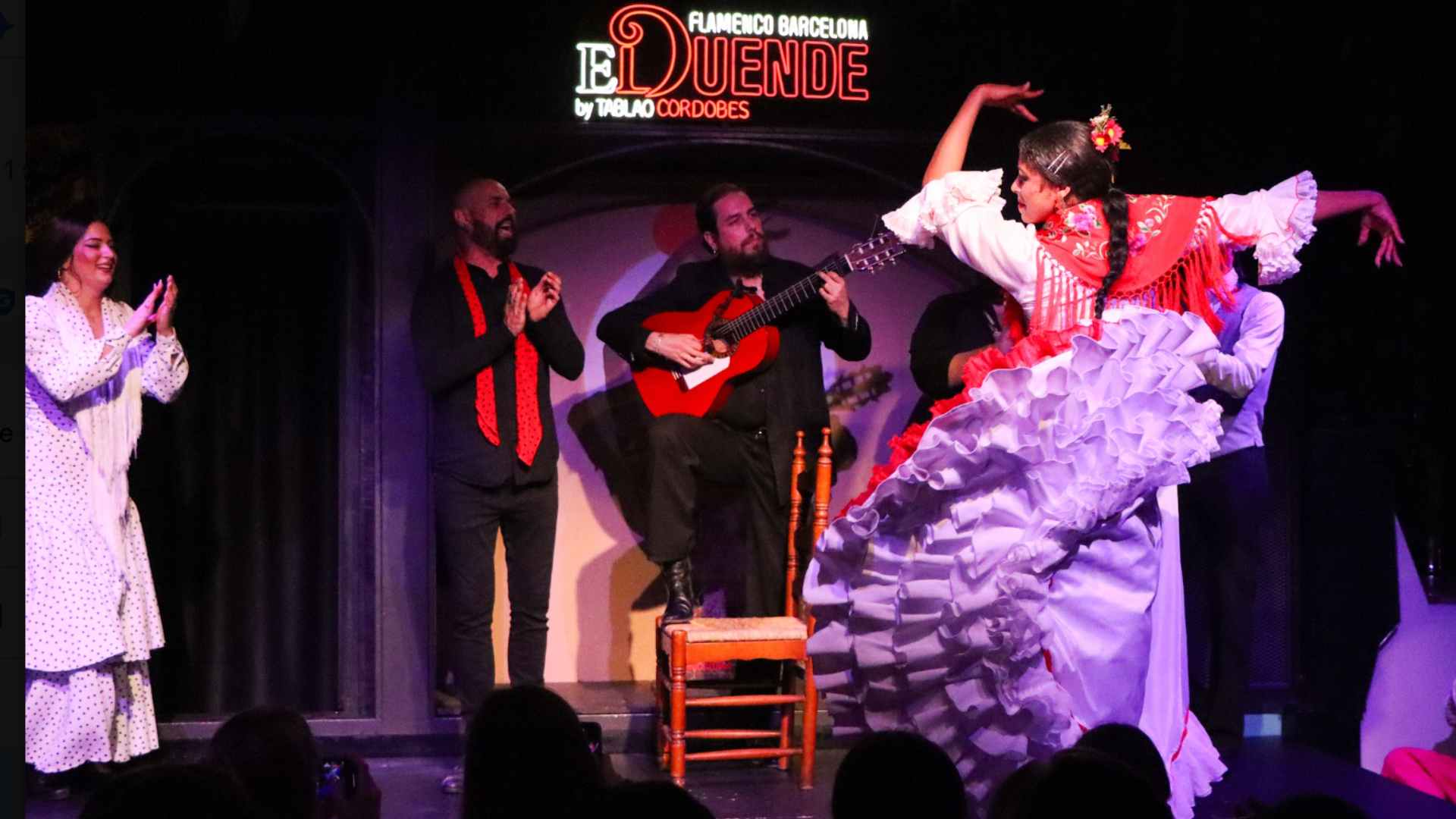
Reading about instruments is a good start. Hearing them interact live is something else entirely, and flamenco offers the richest single setting to do it: guitar, voice, palmas, cajón, zapateado and sometimes castanets, all conversing in real time on one small stage.
In Barcelona, one of the best places to experience this is El Duende by Tablao Cordobes, at La Rambla 33 in the heart of the city.
El Duende continues the legacy of the Tablao Flamenco Cordobes, a family-run landmark of flamenco since 1970, recognized as the Best Tablao in the World 2025.
The venue is an intimate flamenco bar with just 120 seats, which means you sit close enough to see the guitarist's right hand blur through a rasgueado, follow the palmas passing rhythms back and forth, and feel every zapateado strike through the floor.
Shows take place daily at 7:00 pm, 8:15 pm and 9:30 pm, last around 50 to 55 minutes and feature six to seven artists whose lineup rotates constantly, blending renowned figures with emerging talents.
Check-in opens just 10 minutes before showtime, making it easy to fit a performance into any Barcelona evening. Most seating zones include one drink during the show, such as wine, beer, sangria, cava or a soft drink, and the Frontal Zone guarantees first row seats.
Guests in every zone can also order from a curated menu of signature cocktails inspired by the different styles of flamenco, available at the bar.
Final Thoughts: A Country You Can Hear
Spain's instruments form a living map of the country. The gaita carries the mists of Galicia, the txistu echoes through Basque valleys, the timple brings island sunshine, and in the south the guitar, the cajón, the palmas and the dancer's feet gather every night to perform the ritual called flamenco.
Some of these instruments are ancient, some adopted, some as simple as two hands meeting, and all of them remain gloriously alive.
The best way to appreciate them is the oldest one: sit in a small room, order a drink, and let musicians a few meters away show you what centuries of Spanish craftsmanship and passion sound like.
Ready to hear the instruments of Spain live? Book your tickets for El Duende by Tablao Cordobes at La Rambla 33 in Barcelona and experience the guitar, the palmas and the rhythm of flamenco up close.